Monday, July 31, 2006

Food Roundup


I've turned into a food junkie. Not in an unhealthy, trans fat, carbohydrate-soaked, grease-dripping kind of way. More like an unhealthy obsession with health foods, food trends, and Food Network Channel kind of way.

I can't help it. Every time I see that cute-as-pie Rachael Ray in her ill-fitting shirts, I'm compelled to watch the back-to-back episodes. I look at a sandwich and I calculate how many Weight Watcher points I'll lose if I consume it. I look at alcohol and I ignore how many Weight Watcher points I'll lose if I consume it. (you do it too, don't lie to yourself.) You get the picture.

Anyway, over the past week, I've noticed a number of unusual food-related stories. Here's your Food Roundup:


In reference to that last bullet .... seriously?! I do love this country but why does America have to be so poisonous sometimes?


Thursday, July 27, 2006

Single and poor


Oh crap. I'm moving from the No. 2 city in America for singles to the No. 9 city. And how, you might ask, would one rate cities for singles? According to Forbes.com, that all-knowing, hip publication known for its trendy appeal to fun-loving singles, they rated their cities on "nightlife, culture, job growth, number of other singles, cost of living alone, online dating and coolness."

I'm sorry. Coolness? Since when did Forbes become the authority on coolness? Must have been after their stories on Renault profit declines and cutesy, overdone headlines like "EMI and Warner Face the Music."

But, I shouldn't fear about being single in the No. 9 city. Not when I have Forbes' guide to "Snagging a Rich Man." Do check it out, it's worth the watch. The quotables:

"No more dive bars. Dive bars are not where the moneyed hang out."

"The charity circuit is a rich man turn on."

"How do you tell if a man is rich? Moby is rich but sometimes he looks homeless."


Forbes has sunk to a new low.

Tuesday, July 25, 2006

More than words

I've recently become aware of how capriciously we employ certain words in the English language. For reasons unknown, we don't always think through the full meaning of our words, how they affect others, the unintended consequences. And we do ourselves a disservice by such cavalier attitudes, don't we? We cheapen words that should have significance, we diminish the power of their meaning.

For example, when was the last time you really thought about the true meanings of sacrifice, eternity, love, unconditional, hope?

But instead of creating other words to make up for our belittling mouths, we're actually adding to and validating the most shallow parts of human nature. Check out some of the new additions to the Oxford Dictionary:

aerobicized -- adj. (of a person's body) toned by aerobic exercise: aerobicized Hollywood women.

bahookie -- n. Scottish a person's buttocks

celebutante -- n. a celebrity who is well known in fashionable society

crunk -- n. a type of hip-hop or rap music characterized by repeated shouted catchphrases and elements typical of electronic dance music, such as prominent bass

Not that I didn't love RIZE as much as the next person, or adore Billy Connelly any less -- but do me a favor. Put down the US Weekly/Page Six/The Sun for a bit, think about a person you truly love unconditionally, and go out and tell them so. Sure, it sounds cheesy, but hey, it never hurts to think about these things a little more often.

Friday, July 21, 2006

A disturbing view from Missouri

The Missouri Corn Growers Association placed a number of these billboards across the state earlier this year. That's a white farmer in a polo shirt on the left and the former king of Saudi Arabia on the right.

Not that ethanol doesn't have its advantages (and disadvantages too), but can someone please explain to me how this blatantly racist advertisement makes its point? From the Columbia Daily Tribune:

Becky Grisham, MCGA’s director of communications, said the billboards were designed to bring more awareness to the issue of statewide ethanol standards under consideration in the Missouri General Assembly and the overall effort to promote the homegrown industry. "I think it’s done a pretty good job," Grisham said.

Sheesh. And I thought working in communications at Big Red was bad ....

Thursday, July 20, 2006

Make it work!


I'm letting you in on a little secret -- one of the greatest small pleasures in my life right now is watching Project Runway. And, more specifically, watching Tim Gunn, the molasses-voiced co-host who also happens to be the head of Parsons School of Design in NYC. Since I was busy packing up my kitchen last night, I sadly missed the new episode of Project Runway and because Bravo has some stupid new show with a jacked-up woman called (surprise) Jackie, so they no longer air Runway back-to-back. I mean, really. Israel is bombing Lebanon, I need an escape from the dirty underbelly of life and Bravo isn't running back-to-back episodes of Project Runway? Come ON, people.

So, in an effort to stay abreast of the Runway issues, I went to the fountain of all knowledge (the Internet) where to my very great delight, I found Tim Gunn's blog, "Tim's Take." Add that to my list of everyday reads!

Wednesday, July 19, 2006

Ctrl + Alt + Del

My apologies for the blogging break. After I discontinued my landline in an effort to save money, all my neighbors with highspeed wireless internet decided to encrypt their networks. This is what I get for trying to steal internet...

But I'm rebooting the blog -- since rebooting seems to be one of my life's current theme. The down and dirty news -- I'm moving to Washington DC to start graduate school! Originally, I had thought that if I'm going to give up a full-time job and a full-time salary to be a poor student again, I might as well graduate with two degrees instead of one. Hey, I never said I wasn't an overachieving masochist.... so off I go for a three-year program in business and international relations.

The moving preparations are underway ... sort of. At least I have a place to live. And I have boxes from the UHaul man, who told me that the Christians are after him because they keep approaching him and telling him that he needs peace in his life. Which is understandable, since this poor guy just lost two friends in neighborhood violence. I told him that maybe that Jesus guy was trying to tell him something and we shared a few laughs over some of our church experiences gone wrong. But that's not the point of my story today. My story today takes place east of Capitol Hill, near the Potomac Ave metro stop, where I finally end up after a fruitless morning apartment hunt.

I arrived in front of the most rundown house on the street. A big metal door with a dirty window, through which I could barely make out an unlit, dingy hallway with a rickety staircase. But a phone call to Mrs. Banks (the elderly tenant with the keys to the apartment) proved another deadend -- she informed me that the apartment rented the day before. Wishing I could ctrl+alt+delete the entire day, I listlessly walked toward the street where I was greeted by a random woman on a bike, who had stopped to take a cell phone call. (Are there rules yet about driving a bike while on a cell phone?) She started up a friendly conversation with me, I told her about my frustrating house hunt and she told me about a new apartment building a few blocks down the road. So I followed her.

Now, I know this seems like a crazy thing, following a strange woman around the streets of Washington DC's east side ... but ...nevermind, I don't have a good excuse. We finally arrived at a far-from-finished apartment building with a banner that proudly displayed the development company's phone number. She went on her merry way and I disheartedly copied down the number. Another ctrl alt del moment.

But as I turned, I caught a glimpse of a woman pulling out brand new, flattened moving boxes out of her car across the street. She struck up a conversation with me and I relayed my entire tale of woe and anguish. She then proceeded to tell me that she was being transferred to London for two years and needed to rent out her GORGEOUS two bedroom row house.

I guess sometimes we just have to let life play out before rebooting everytime ...

Saturday, May 13, 2006

Adjusting to the States

I've been back in the States for five days. And it almost feels like I've never been gone. Boston is just the same, although the trees have leaves now and the lilacs are blooming and it's been raining everyday since I returned. The top three things I've noticed most about being back:

1. Americans love their cars. I was aching to drive my car again when I got back but have been struck by how little I walk around, now that I have wheels. Seems a bit of a shame and I've decided to walk more and take the T more often.

2. Americans are not healthy. I'm currently in Buffalo, NY, for my little sister's college graduation and have noticed more than anything else, the large numbers of large people here. I just spent a month in a country where the people are too poor to be fat, so the sudden appearance of obese individuals around me is rather stunning. And kinda gross, not gonna lie.

3. I only spoke English maybe 10% (or less) of the time I was in Bolivia. Since I returned, I haven't spoken a lick of Spanish, until today, but that was because I received a phone call from Bolivia. I better figure out a way to speak the language while in Boston.

Been thinking about how to recap the whole month and will have pictures up soon. I'm already missing the boys and my work down there, so composing the summary will be a nice way to revisit them ...

Sunday, May 07, 2006

Conquering the World's Most Dangerous Road (and a spider)

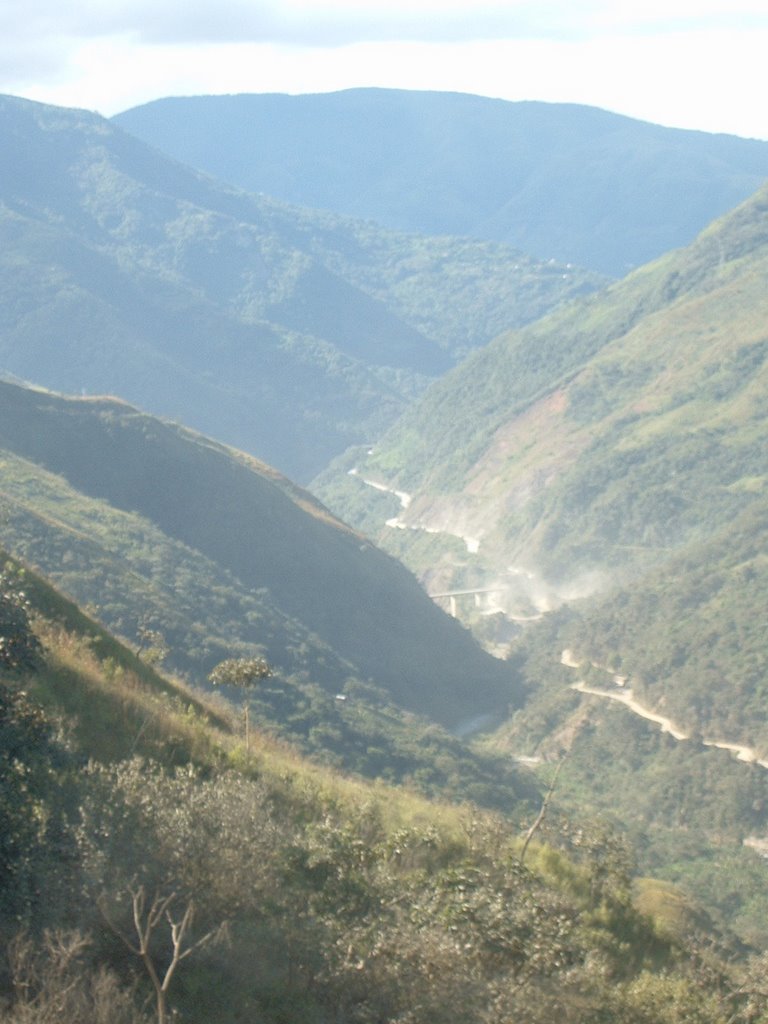
Forget the stunning views. Forget the World's Most Dangerous Road (WMDR). Forget driving along the WMDR in a white blanket of fog with a visibility of 5 feet. What I will remember from my trip to Coroico is killing the world's biggest spider -- in my bedroom.

I had just wrapped up a lovely conversation with a young French activist named Gregory, after a lovely souffle dinner and a chocolate and banana crepe for dessert, and retired to my room, settling down as comfortably as possible on the flattened "mattress" pad that provided only the slightest bit of cushion. Suddenly, I saw an ugly brown, 4 inch long monster with eight legs creeping up the opposite wall -- you know, the kind that doesn't spin a web to catch food; it hunts for food.

Naturally, I did what anyone else would do -- I screamed and threw on my shoes to run for help. Trust me, had you seen the whopper, this would have been your first instinct too. But then I thought the thing might crawl into my bag, so I shoved everything into my bag, zipped it, and then started to run for help. But the freakin' creature kept moving! Gripped with a sickening fear, I resigned myself to doing the deed. I mean, what if it disappeared under my pillow just as I found someone else to kill it and we couldn't find it and I'd have to die a slow, painful, spider-induced death in my sleep? That just wouldn't do. So, I tore off my boot and cautiously approached the intruder, all the while telling myself that I was a lot bigger than it. I think it understood what I was saying because the beast took off like a rocket. After a short chase, the ghastly brute tried to sneak behind a thatched wall hanging and I mercilessly smashed it through the decor -- once, twice, six times just to be on the safe side. Thus ended the Hunt for the Great Arachnid. It then took about 20 minutes and 736 glances around the room for my heart to stop racing. I hate spiders.

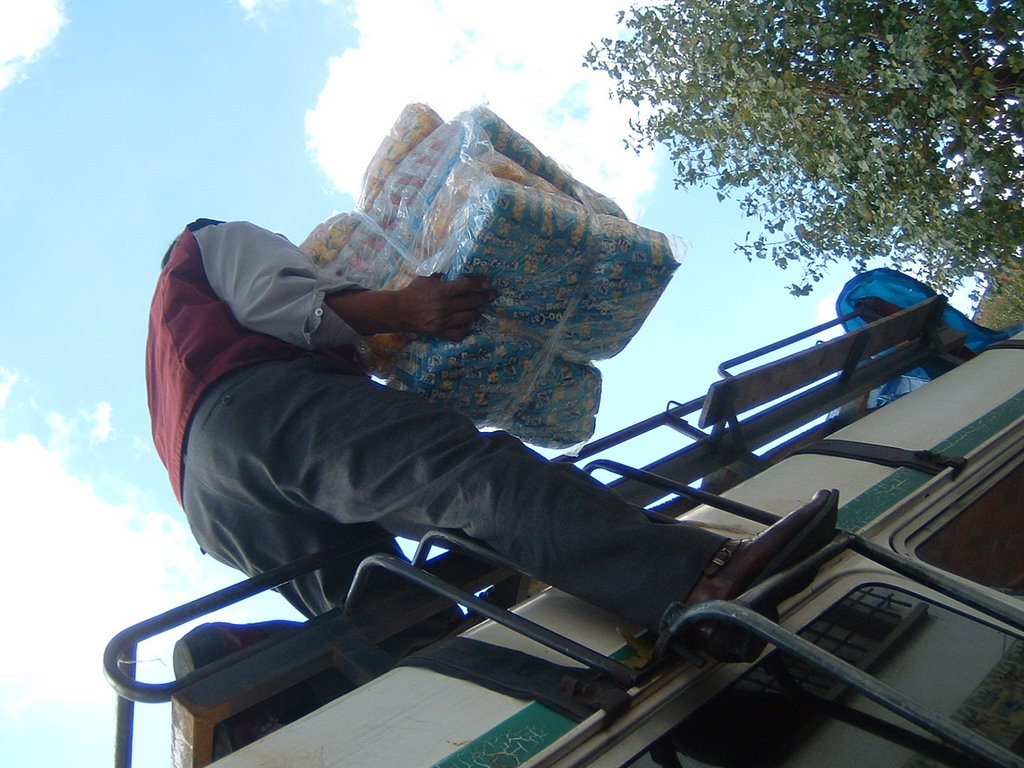
So right. Back to the World's Most Dangerous Road. According to the Inter-American Development Bank, an average of 26 vehicles disappear over the edge. That's about one vehicle every 2 weeks. However, La Paz locals assured me that it was fine, as long as I don't travel at night. So, I merrily booked a seat on the 3pm minibus (which turned out to be a bigger, scarier microbus). As I watched the driver load up the cargo on top of the bus, a 70-something drunk Bolivian man named Miguel tried to befriend me and I quickly moved away. What is it with me and 70 year old Bolivian men?

We finally boarded around 3:10 pm and guess who was sitting next to me? For the next three hours, Miguel imbibed what smelled like rubbing alcohol, blabbed about his 10 wives, sang love songs, and invited me to his house 18 times. Here are a few of the English equivalents of my side of the conversation: "Yeah." "Whatever." "Why do you think I'm going to do that?" "Who talks like this?" "Why are you touching my arm?" "I'm not sad, you just talk too much. Go away." I became rather rude by the end of the 3 hours.

And I learned that the only thing scarier than driving down the WMDR at night
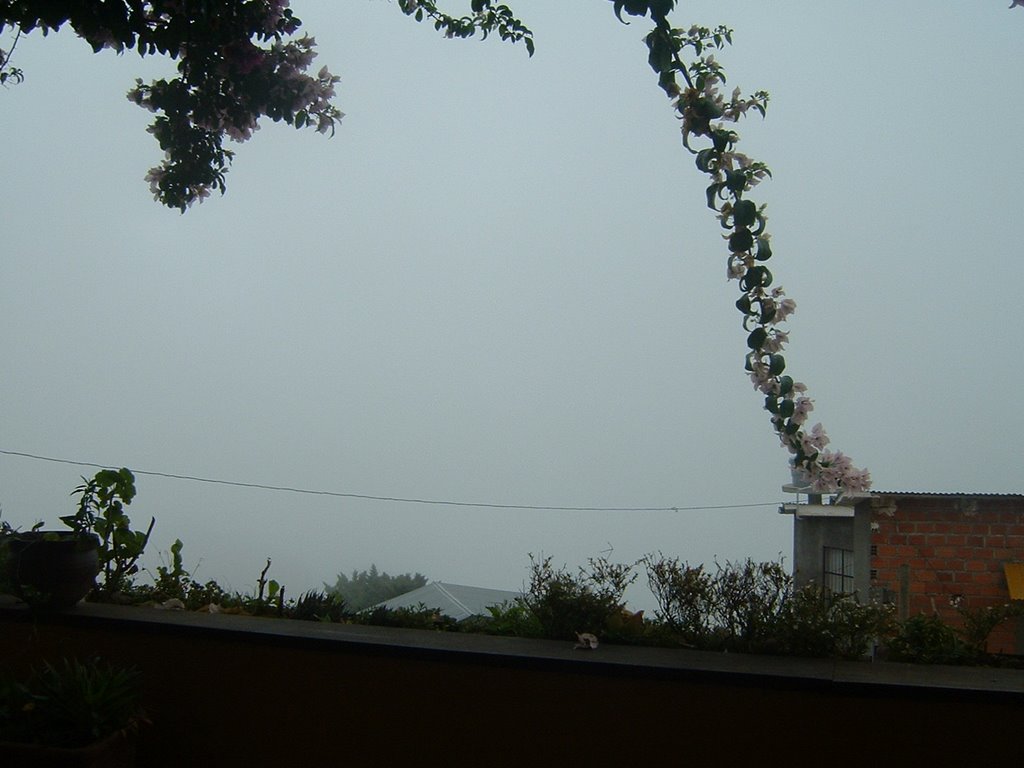
is driving in a fog (and co-habitating with giant arachnids). That's the driver you see over on the right. Notice how you can't really see anything out the window. Eventually, after 2 excruciating hours of blindly winding down a narrow, unpaved mountain road, the fog partially lifted and I caught a glimpse of purple mountains in the distance and big, green, leafy vegetation everywhere. Unfortunately, the view lasted about 20 minutes and it was nighttime. When I finally fell asleep around 2am (with the light on, hoping it would prevent other vermin of the night from emerging), I comforted myself with thoughts of the breathtaking view in the morning light.

After a restless sleep filled with coughs and sneezes (I've got a cold), I woke up in a fog. Literally. No view. Nothing. Just a lot of thick white fog that nestled itself into every possible crevice of the landscape and suffocated it. I walked to the center of town, keely aware of how out of place I
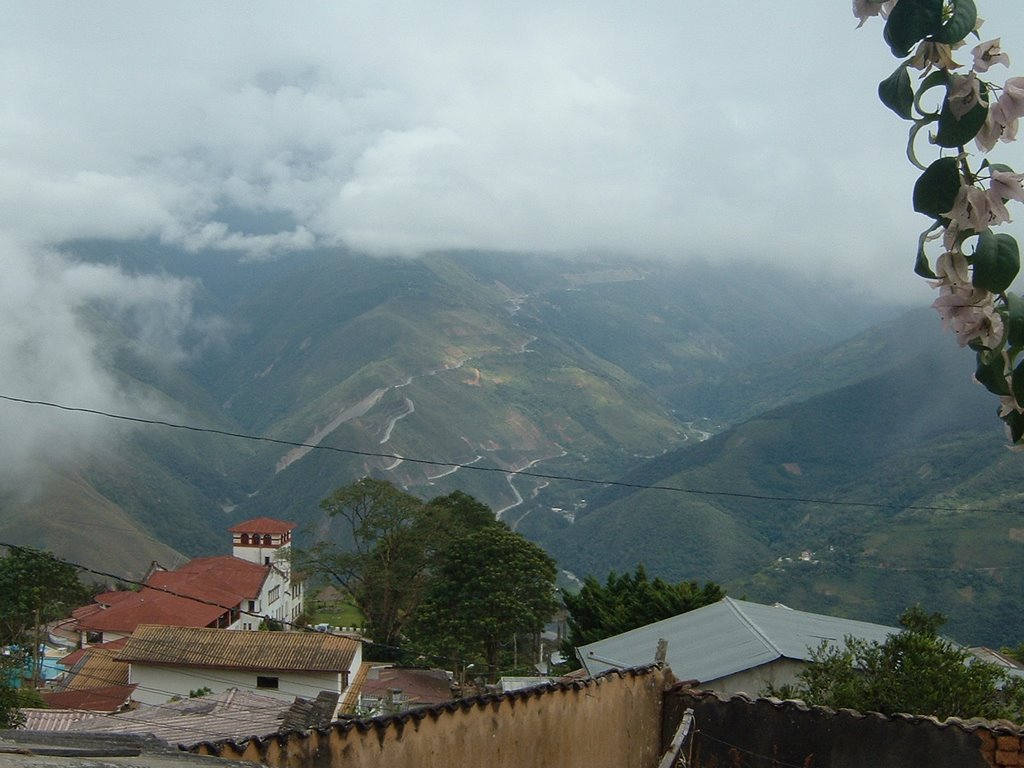
looked into this itty bitty pueblo and chose a German spot for breakfast. Facing the white sheet that had been pulled over the land, I enjoyed the first decent cup of coffee I've had in a month, and chatted with a couple from Denmark. But as a bizarre mix of Bob Marley, opera, Eric Clapton, bad 80s electronica and samba tunes swung through the air, shy Coroico slowly parted her cottony curtain to reveal a lush, emerald green vista. I oohed and aahed diligently, snapped photos, and still came to the conclusion that I would rather sleep in the spider-free comfort of Zona Sur in La Paz. I had just enough time to change my bus seat, walk around the center plaza, and chill out on the hostel's mountainside deck. Interestingly enough, I ran into yet another 70-something Bolivian man, who struck up a conversation with me during the uphill trek back to the hostel -- at least this one was nice. He'd worked on a merchant ship that brought goods back and forth from China, Japan, Hong Kong and Taiwan.

The ride back to La Paz was wonderfully uneventful, although I bet the other passengers were quietly laughing at the Asian tourist who kept opening the window to take pictures. I've posted below some of the better pictures of Coroico and the ride back. As picturesque as it all is, I was glad to finally make it back to the place I've called home for the past month. Plus, cutting the Coroico trip short meant that I would have one more opportunity to see the boys I had to say goodbye to on Friday. More on that tearful goodbye later. I return to the States tomorrow, hardly able to believe that I've been in Bolivia for a month.

Wednesday, May 03, 2006

Feed the birds

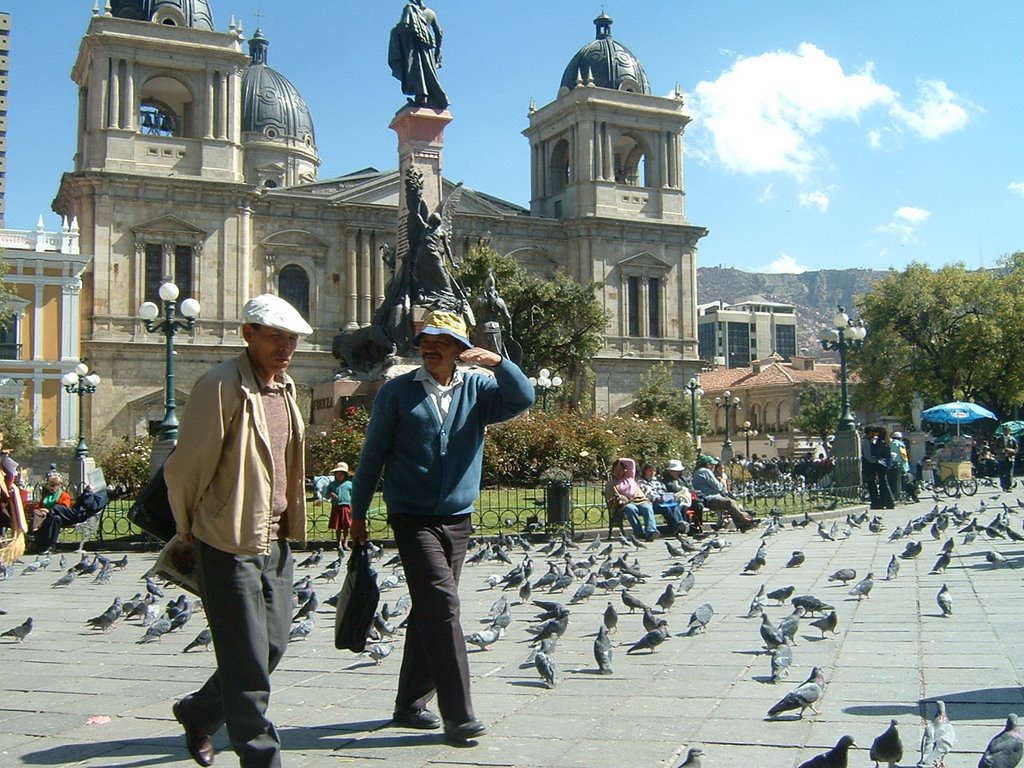
I finally made it to La Paz's most picturesque and most important plaza yesterday -- The Plaza Murillo, where last year, 80,000 protestors surrounded the presidential palace (left) to demand the nationalization of the gas industry and where, just two days ago, President Evo Morales announced that the country's gas reserves would be nationalzed. Bolivia has the second largest gas reserves in South America and, thus far, has reaped very little reward from it. In theory, this new development should increase energy-related revenues to $780 million, almost six times what they received in 2002. Of course, you have to hope that, in a departure from most of Bolivia's previous leaders, Morales won't use the new income to line his own pockets. Hopefully his two best friends, Hugo Chavez and Fidel Castro, won't negatively influence him. (Of all the world leaders to call buddies .... )

Plaza Murillo is kind of the Trafalgar Square of La Paz. Pigeons are everywhere, people are lounging about on long lunch breaks, vendors sell bird food for tuppance a bag ... or was that in
Mary Poppins? Anyway, I hung around for an hour or so, played with a cute-as-a-button, random 3 year old girl, watched other children torment and chase pigeons, which didn't bother me since they are nasty, vile, dirty things. The birds, not the children. That's the 1835 cathedral on the right.

With more time to spare, I wandered down toward the San Francisco Plaza, where all kinds of handicrafts, trinkets, and other goods are on sale. Accidentally stumbled into the flower market (literally, fell into a stall. Luckily, the lady was very nice to me) and then put my negotiation skills to the test. My father would have been proud -- although I had to concede $30Bs (less than $4US), I put the vendor under enough pressure that she had to call her boss to make sure the deal was okay. I love when that happens!

Tuesday, May 02, 2006

The free radical

I've been reading The Beatitudes (Book of Matthew, Chapter 5) this week and have been pondering the crazy, radical teaching of Jesus. I mean, this guy talks about lifting up and rewarding the meek, the merciful, the pure in heart, the gentle, the peaceful -- it makes me think about the people, celebrities and heroes we look to as role models, and wow, so few of them exhibit those characteristics. And I dare you to name a world leader who fits this bill!

In my readings, I also came across a great summary from author John Stott, who said "In brief, Jesus congratulates those whom the world most pities, and calls the world's rejects 'blessed.'"

What comes to mind immediately are all the children that I've been working with during the past month: the street children who are rejected by all the other shelters and turn to drugs and prostitution; the boys who shine shoes to earn a few cents but wear scarves covering their entire faces to avoid the stigma of being on the street. The ones who drool and can't form complete sentences because they are so high on thinner. The poor family who can't afford hot water, the mother who sells handicrafts on the sidewalk and has no choice but to allow her three-year-old to play in the street. This would have been the crowd that Jesus would have hung out with, the ones he would call 'blessed' or 'happy'. Way to be.

I'll tell you who I think fits the bill in those first 10 verses of Matthew 5. His name is Israel and he lives in the Renacer Home. At 13 years old, Israel is the sweetest boy I think I've ever met (besides my lovely boyfriend who will pick me up from the airport on Monday, right, babe?) Israel is the quiet kid in the back of the classroom, who doesn't need to bounce in his seat to show the teacher he knows the right answer. He doesn't have his own desk (probably because the louder and more showy kids grabbed them first) and instead has to share a wooden table with another boy. Like me, Israel absolutely loves to read; he's also an artist, loves to take photos and he shares all his stuff with the rest of the boys. He's the one who cares for the adorable kitten, Estuart, and tries to avoid unhealthy conflict whenever possible. But he's not a pushover -- he's athletic, plays football, does your normal 'boy' stuff too. I know I keep saying this, but I can't believe he used to be a streetkid. I just hope he doesn't lose these wonderful traits, that he doesn't became jaded by life's twists and turns, that he keeps hold of his imagination and creativity. This small, quiet 13 year old boy is truly the salt of the earth.

How would you like your corn?

A few Cochabamba statistics for you:

1. In this region of Bolivia, there are supposedly nearly 100 types of corn and 200 types of potatoes. I haven't had a chance to really research it, but it sure seemed that way. I, personally, enjoyed various types of corn four different ways -- off the cob, api (a sweet drink), tojori (another drink), and chicha (an alcholic brew made from corn and tastes kind of like Mike's Hard Lemonade). It was Orieta's 76-year-old aunt who took me out for a drink during my visit.


2. Cochabamba boasts the biggest open air market in South America. Called La Cancha, it is the most overwhelming, dizzying, exhausting market I've ever been to. Imagine the craziest outdoor market you've experienced and multiply it by 200. Now you're close. Filled with fake Gap, Ralph Lauren, Nike, Puma, you name the brand, La Cancha goes on for blocks and blocks -- even the markets in Bangkok couldn't hold a candle.

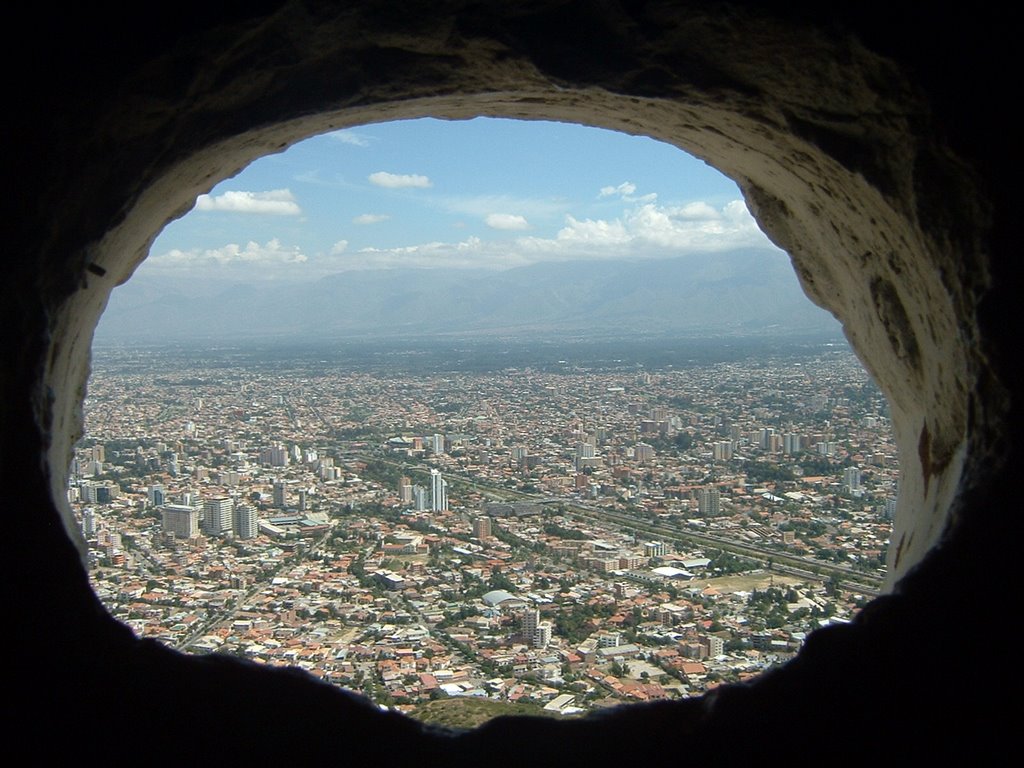
3. They also boast the highest statue of Christ. The more famous statue in Rio de Janeiro rises to 33 meters, one meter for each year of Jesus' life. The Cochabamba statue is 33 meters and a few centimeters, justified by the Cochabambinos because Christ lived "33 years and a little bit." I climbed to the top of the statue and peered out the small holes, which provided the only light inside. My quads were so sore the next day and I'm blaming the altitude. And if you have a problem with that, you can race against my super-duper new lung capacity when I get back to the States.


4. Never, ever take the last bus out of Cochabamba. Especially not on the eve of The Day of the Worker (May 1). For more details, read the next entry.

Monday, May 01, 2006

Beware of the last bus

While the weekend in Cochabamba was highly enjoyable and quite interesting, the highlight of the trip was actually the bus ride, both to and from Bolivia’s third largest city. I’ll take a few minutes later to write about the stuff I actually did and the food I ate, but this session is devoted entirely to the transit turmoil.
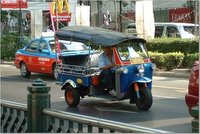
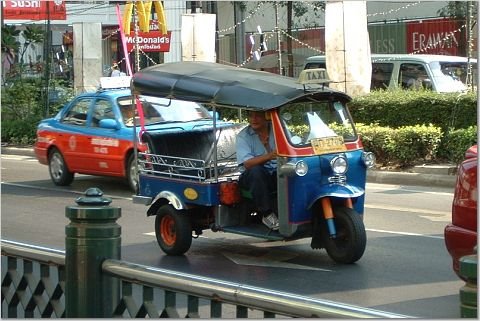
The way to CBA is your typical, detestable 7-hour bus ride: dirty, creaky, infested with crying babies and body odor, packed to the hilt (including a filthy, white dog named Violetta). And a kung fu movie from Thailand, which, no joke, featured the best and only tuk-tuk chase scene I’ve ever watched (see left for a tuk-tuk) . At first I thought the movie was just to help pass the remaining four hours, but I soon realized it’s true purpose is to distract you from the treacherous, narrow, winding road through the mountains that your big, double decker bus is trying to navigate in pitch black darkness.

But, the experience was mildly worth it – everything from the La Paz bus terminal where bus companies hire people to yell their destinations at you, to the random $2Bs extra fee you pay to get to where the buses depart, to the vendors who hop on and off the bus during your journey to sell drinks, snacks and ice cream. It’s almost like being in a moving baseball stadium. Almost.

After the kung fu movie ended, I tried to look out the front to see the road, but the oncoming trailer trucks, the freaky cliff drop to the left, and the way the bus clunked on the severe curves (the same way my old Nissan did when the mechanics told me my axle was about to snap) all made me a little nervous, so I opted to watch the sky. Good move – I quickly became enamored with the all the stars, and it was as though I’d never really seen the night sky before; the way it’s deepness opens up over the mountains; the Southern Cross; how stars sprinkle light upon the landscape … Unfortunately, I think the magic of the moment was lost on my travel companion, Orieta, who was understandably suffering from motion sickness. I, however, dozed off with the pinpricked image of the sky in my head....

And then there was the return trip.

We booked ourselves on the last “red eye” bus out of CBA at 9:30 p.m. (This is a highly important piece of information and you should remember to never, ever, ever take the last bus. Ever. )

The trip started out deceptively normal. Crowded terminal, people yelling, full bus, crying babies, smelly bodies, dirty dogs. But after we left the terminal, our bus paused just before turning onto the street and a few more people got on. Except that there weren’t any seats for them and they sat in the aisle. Now, my first reaction was, oooo that SUCKS to sit there for the next 7 hours. But the other people around me were annoyed and they started to call out the window, “We’re full, you can’t pack people in like this. Let’s get going!”

So, away we went … until the bus paused again and then again in other parts of town, where there were (I kid you not) at least 50 more people waiting, all with gigantic and heavy bags, suitcases and packs. Most of them were poor, indigenous background and in “chola” dress, with their babies strapped to their backs in colorful blankets. And the fun began. The people who paid full price were outraged – and they really started to yell. “It’s not safe! You can’t put more people on this bus! Get moving! Go!” They were yelling out the windows, they were getting up and yelling down to the door, they were riling each other up. Whoa. Being a little naïve, I started thinking, oh what’s the big deal? These are poor people who need to get back home and this is the last bus (I told you that was important info). And then I started thinking about an overcrowded, overweight, overstuffed, double decker bus rushing around the violent curves of the mountain road. And I decided that I would prefer not to die on a bus in a mountain crash in Bolivia.

Orieta went down to see what was going on and came back to tell me that the driver was drunk and was actually packing people and their stuff into the baggage hold under the bus! And that three months earlier, a bus had gone off the road because it was overweight for the same reasons and more than 20 people died. Fabulous. Now, the aisles were more full, people were calling the police, Orieta told me to start taking photos out the window to document, and everyone decided that when the bus arrived at the toll booth, we’d yell for the police and get the driver to stop.

Which is what we did. So the bus pulled over, we got out and found ourselves faced not only with the driver and the solitary police officer, but with another 20 or people who wanted to get on our bus. I started snapping photos of the bus license plate and the bus, which angered the Indians because they thought I was taking pictures of them. Luckily, they were quickly distracted by all the bellowing around the police officer.

I’ve never experienced anything quite like it – the yelling started out about the safety issue. Then it turned low-blow, an outlet for pent-up anger and frustration, just plain ugly. One woman shrieked that this was her country and even though she was poor, she had a right to be on the bus – which didn’t go over well, since nearly everyone else on the bus was also Bolivian-born. Others were howling for respect, others for fairness. In this one evening, I felt the fuel that has caused Bolivia to experience more coups than any other South American country, that causes the thick line dividing rich from poor to burst into flames. No wonder, then, that a poverty-born, coca leaf grower, Aymara man named Evo Morales was elected president of the country.

Back at the toll booth, the vein-popping, face-reddening screaming continued to escalate and then a man started to yell out “Let’s blockade the bus! We can block the bus right here, form a line of people to blockade! Blockade! Blockade!”

Oh, please, no.

The next thing I knew, we were being herded back on the bus, still with the yelling all around. I heard some woman scream out about “La china” (me) taking photos and some other woman came over to kick me in the back of the legs. Which was rather ineffective and I just looked right at her quizzically. She didn’t have anything to say, so I just gave her a disgusted look and boarded. The police officer came through to make sure that everyone actually had a seat (although he made a few exceptions). And when he left, the second, sober driver snuck a few people into the bottom of the bus. I rationalized with the butterflies in my stomach that at least the aisles weren’t completely packed.
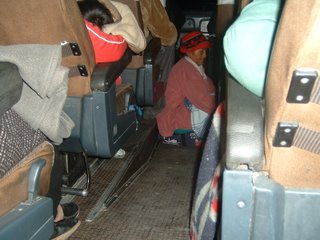
Needless to say, the stars didn’t exactly provide the same relaxation as the first trip. Times like these, I’m so glad that I believe in a God who listens. I was praying like crazy, but figured that the Jesus guy who calmed the wind, rain, and sea could probably get me back to La Paz. I eventually settled into a restless sleep that was interrupted by the periodic snoring snorts of the old woman across the aisle, the oncoming trucks that honk at you just to double check that you know they’re coming, and the bumps of the road sections that aren’t paved.

After dumping our stowaways and all their luggage out of the bus a block from the bus terminal, we had finally made it to La Paz and hurried into the first cab available … only to find that our cab driver was more than a little drunk and babbled the whole way about Venezuela, how much he pays for gas, and how he doesn’t fight with his wife. Oddly enough, the ride didn’t seem any less spastic or horrifying than a normal taxi ride with a sober driver in La Paz rush hour. At 5:37 a.m., I finally crumbled into bed, safe and sound.

After that, a ride down the Road of Death next weekend should be a cakewalk.

Friday, April 28, 2006

Gone shopping ...

The best thing about countries like Bolivia are the black market -- yesterday, I went to a nontourist market that sells all contraband stuff. Sunglasses, electronics, all kinds of home goods sell for dirt, dirt cheap. I bought fabulous "designer" sunglasses for all of $6.

Today, Orieta and I head off to Cochabamba, her home town. The third largest city, Cochabamba lies in the center of Bolivia and hosts what is supposedly South America's largest open air market. Lonely Planet calls it nerveshattering ...

We'll see how I survive!

Wednesday, April 26, 2006

The Work

I realized that I haven't actually written much about what keeps me occupied on a daily basis. So, let's take a walk through a typical Bolivian day in the life of Lady V.

The day usually begins with a Bolivian breakfast -- coffee and bread with butter or jam -- over a Bible study. I make my way to the Renacer Home via two trufis, most of which do not feature working spedometers or gas gauges. Unlike the other shelters, The Renacer Home sits in Zona Sur, a good distance away from the downtown area where the street kids hang out. After all, street kids are pretty hard core, they huff paint thinner, they cut each other up, and they can be as young as 10 years old (actually, some are younger). Even if they step into a shelter, they're not exactly equipped to withstand the temptation of drugs and alcohol on the doorstep.

When I arrive at Renacer, I'm always greeted with an onslaught of hugs -- all six boys have been off the streets for about a year and they are starved for attention and affection. They're usually playing marbles in the front yard, which like most homes down here, is fenced off by a brick wall. For the most part, it's a good natured game :) I have a hard time imagining that these kids who are healthy, chattering and laughing used to live in makeshift shacks by the river. The Choqueyapu River, by the way, is supposedly the world's second most contaminated river, after The Ganges in India. It's estimated that about one-fifth of the trash produced in La Paz each day finds its way into the "river."

Around 9:30, we enter the one-room classroom, which is outfitted with a small chalkboard, a sparsely filled bookshelf, grey metal lockers for the kids' stuff, a desk for the teacher, four student desks, and a wooden table with two chairs from the dining table so the other two kids can sit somewhere. The world map on the wall is from 1986. What books they have are used or out of date, and there aren't enough to go around. The walls are modestly decorated with a few posters created by the kids or typical classroom pieces like a poster of the alphabet.

I generally help the teacher keep the kids in order and answer the millions of little questions they have. A lot of the pedagogy in Bolivia involves copying information from the blackboard and you wouldn't believe how many times they just want clarification on a word on the board. At least I can handle that! Meanwhile, there's always at least one kid who doesn't really understand what he is copying, so the teacher and I walk around and check up on them. The boys have an hour and a half of lessons, a short recess, then another hour or so in class before lunch. They cover all the normal topics, like math and science, social studies, language, physical education.

Today we talked about scientists and came up with ideas for inventions. I also led an acting workshop, where we practiced being "mirrors" and understanding how to pay attention to what the other actors around you are doing and how to react. Then, we acted out the story of Puss in Boots, which didn't end up being much like the story but I think we all had fun.

We also had a minor scuffle between two boys in the classroom and some cuss words were said, so discipline was the next lesson on the docket. An interesting topic actually - we're dealing with street kids who are still pretty fragile. They don't have the coping mechanisms of 'normal' children and the smallest thing will make them want to run away. So, the BCSP has a policy on disciplining and making sure the punishment fits the crime. There's even a policy on how to handle situations when a kids says he wants to leave. At first, they used to have a talk, try to reason with them, but wouldn't keep the kid in the home against his will. Then, they remembered that any other sane parent would simply send their 12-year-old kid to his room if he said something like that. Which is now the policy and it works. I know I've said this before, but the BSCP is about creating loving, solid, Christian homes for these children -- it's not about being a place to sleep.

The boys all have chores, like setting up the table or cleaning the bathroom, and they have been taught normal Bolivian etiquette and table manners. (Example: asking for permission to leave the table for any reason, saying "gracias" to everyone when you're done with your meal). I usually join them for lunch and we chat about football, what they did the day before, that sort of thing. They like to learn new words in English and always ask about what life is like in the U.S. I spent a good deal of lunchtime today trying to explain the Serengeti in Spanish.

Leaving is bittersweet. Again, hugs all around and they often ask me to stay longer and always ask when I'm coming back. As dear as these boys are to me now, after five or so hours, I'm always exhausted! (This trip has confirmed that the teacher's life is not for me, although I have an incredible new appreciation for our underpaid, underestimated, overworked teachers in America). The boys usually see me to the door, unless a really intense game of marbles is underway. On Monday, the newest boy even stood with me while I waited for a trufi, hailed it down for me, and opened the cardoor. Before coming to Renacer, he had been on the streets for around five years and though we don't know his exact age, he's probably 13. Even with limited resources, just few books, and a tough past, he's turning into quite the little gentleman!

Tuesday, April 25, 2006

Tiwanaku

Tiwanaku. A civilization which ended at least 200 years before the Incas existed. That's pretty mindblowing. Unfortunately, the Tiwanaku ceremonial site has been so looted over the years that we don't know much about them. (In fact, the nearby town church was built using many of the stones from the ruins). Luckily, new discoveries are made every year -- I think just last year, they realized that there were mummies underground and a whole maze of tunnels and tombs.

Speaking of tunnels, I needed one as I attempted to catch the tourist bus to Tiwanaku. The morning had started off relatively well - I managed to wake up on time after the late night wedding party, had hopped into a cab, and was enjoying a nice chat with driver when we kept getting diverted by the traffic cops. Come to find out that of all the 365 mornings of the year, the morning of April 22, 2006 just happened to be the day of the biggest marathon in La Paz. Go figure. Naturally, the marathon course followed the one main road of La Paz and, naturally, that was the one road that I needed to cross to get to the bus. With three minutes before departure, I hastily called the tourist company, who told me that the bus wouldn't leave until 8:30 and that I should proceed to the storefront.

After frantically searching for a tunnel to cross under the road, I gave up and just crossed the road when there was a break in runners. I don't think the police saw me. I finally arrived at the storefront, where Luisa was waiting for me -- not to walk me to the bus but to tell me her life story, which included working as a maid for the American Embassy, being wrongfully accused of stealing, getting married, and becoming a tourist company agent. After this 45-minute chat with Luisa, a woman named Lucy appeared, who walked me to where Isabel was standing, who walked me to the bus, which was filled with tourists who had been waiting 45 minutes for me. Typical Bolivian communication breakdown. And don't even ask why it took three different women to get me to the bus.

We finally got on the road and I made nice with the other folks, who were from Ecuador, Germany, France, Belgium, Holland, England and Australia. And they had all been traveling for at least 2 weeks, with 3-7 more weeks ahead of them. I was green with envy. The French woman was also green, but with a stomach bug that forced us to pull over while she vomited. That earned her the title of "most-hated tourist on the bus" instead of me. Was it bad of me to think that?

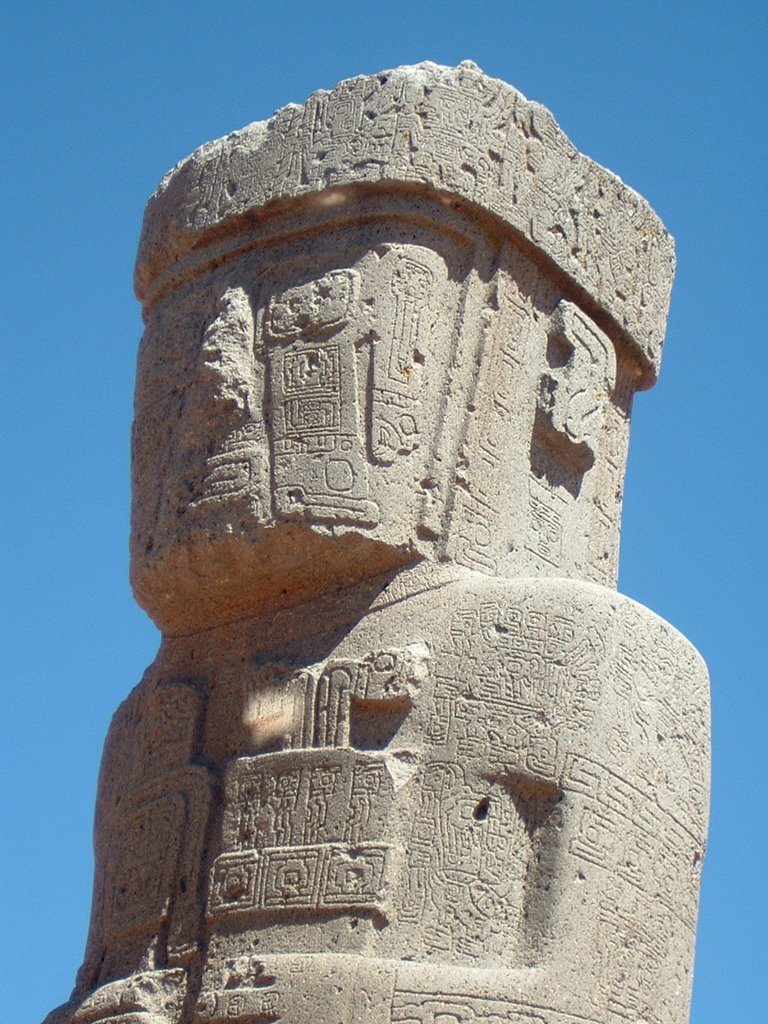
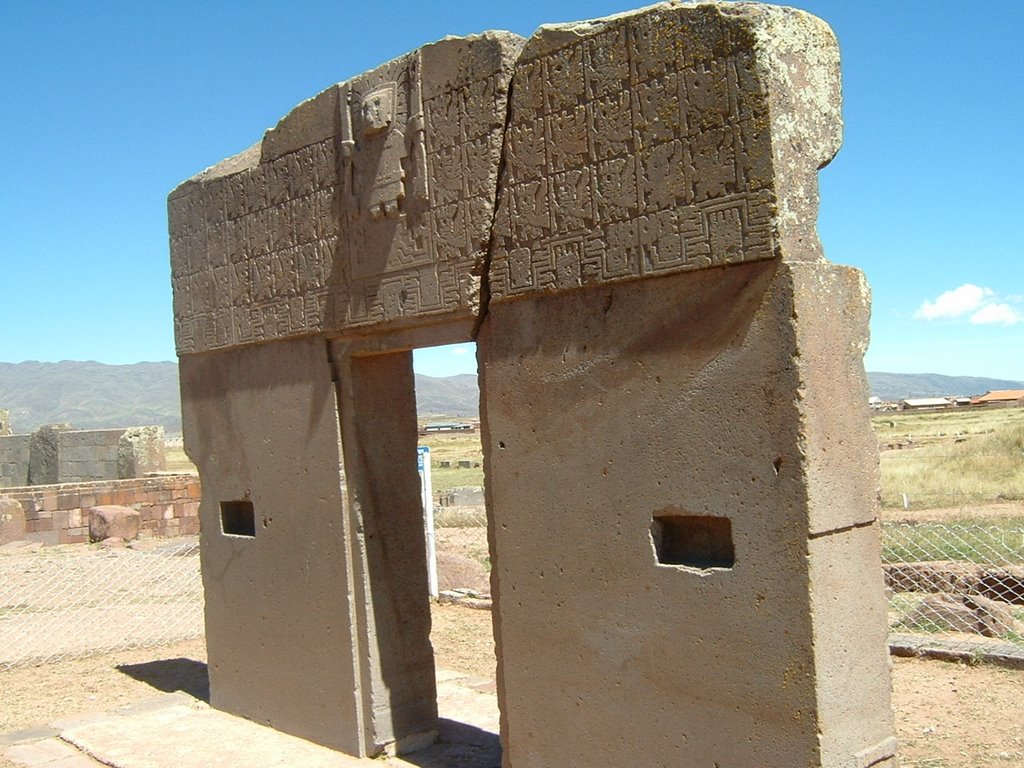
Anyway, the ruins themselves aren't actually much to look at right now. There are some impressive monoliths (above) and the incredible carved Gateway of the Sun (left) made of one single stone, but it's nothing like Machu Picchu (or so I've heard. Haven't made it there in person yet). That's about it. Still, having been built between the 4th and 8th century AD, Tiwanaku makes your imagination run wild -- how did these people transport 25-ton stone blocks, which had to have come from either Lake Titicaca (40km away) or the nearest sandstone site (5km away)? And how did they figure out that the site of the Akapana pyramid is equidistant from the two highest mountains in the distance? How did they build the Kalasasaya temple so that the sun's rays would would cut through it diagonally and perpendicularly on the solstices and equinoxes? Just amazing, thrilling, and magical stuff.

We stopped for lunch at a local restaurant, where I ordered the fish because I didn't have enough nerve to order the llama. But the nice Swiss man offered me a bite of his llama lunch. It was delicious, and evidently is much healthier for you than any other meat.

We arrived back in La Paz about 45 minutes later than scheduled.

The View

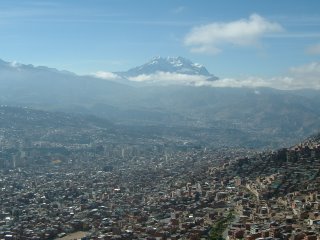
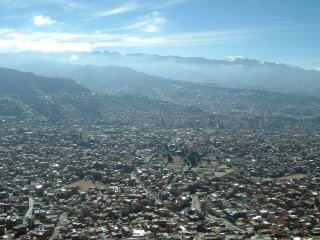
Got a chance to snap a photo of my first view of La Paz. It's a little misty, but you can see why I'll never forget it and why I want to share it with you. The snowcovered mountain in the distance is Illumani. Enjoy.


Sunday, April 23, 2006

Dancing with Napkins

I got myself invited to a Bolivian wedding last night! And I didn't even know who was getting married until I was being driven to the church. (At least it wasn't my own wedding). What happened was that Orieta made me cancel my trip down the World's Most Dangerous Road to enjoy free food and dancing. Not a bad trade off.

Since I hadn't anticipated attending a Bolivian wedding (I mean, who does, really?) none of my clothing was appropriate. But Orieta came to the rescue again, borrowing a formal black dress and shoes from a friend. Orieta, by the way, has very useful friends, including a parking lot attendent who moonlights as a tailer and a woman who comes to her house to sell clothes from a store in Spain at a fraction of the price. I can't say the arrangement strikes me as completely legal, but at least I'm getting some fabulous clothes tailored to fit me perfectly ...

But back to the wedding. It was all fun and good -- Orieta's 20-something nephew oogled the new Asian girl (um, that would be me) for awhile before asking her to dance and then later that night, I somehow got stuck dancing with a 76-year-old wrinkled Bolivian man who really, honestly thought he had moves.

My second favorite part of the evening was when the music periodically switched from Bolivian to American. Specifically, during the cake cutting bit, the DJ played James Blunt's "You're Beautiful." Now, if you don't know the song, it's about a boy who never gets the girl of his dreams. I kept wanting to ask if they actually knew what the song was about, but figured I should just keep my mouth shut.

My all-time favorite part of the evening was when the music switched to traditional Bolivian tunes. Suddenly, the dance floor was PACKED with Bolivians waving white napkins. I have no idea what the napkins are about, but aside from the one moment when I needed to clean the cake off my fingers, it was such a joy to watch these people dance! They were having such a great time, all ages, all sizes, all dance abilities - it was as though the highlight of the evening had suddenly arrived, like when you're at a club and the mediocre music is played at first, but then two hours before closing time, they just crank it up with the fabulous tunes that get everyone doing their D-Qwon dance moves. It was just like that! In Spanish.

It really is too bad that Americans don't have dances that transcend generations like that. (The chicken dance and the electric slide do NOT count). As much as I love to shake things up, there is something so wonderful about traditional music and dance, especially in a country like Bolivia that has just been through so much hardship. The dances always symbolize something; they are reminders of past joys and sorrows; they are beloved by young and old alike.

The evening finally came to a close for Orieta and me around 1am (even though we were supposed to leave at 9pm). It was a struggle waking up this morning -- to get to the Tiwanaku ruins, I had to catch an early bus. Which ended up having to wait 45 minutes for me because of a marathon and a talkative maid-turned-tourist agent. But more on that later when I piece together my thoughts and post up a few pictures.

Saturday, April 22, 2006

House vs. Home

I came down to Bolivia for a two main reasons -- to better understand how U.S. organzations can partner with organizations in other countries to solve social injustices, and because my faith demands that I live a life serving other people.

More than anything else so far, I've learned the difference between a house and a home. Houses, or shelters, are what most organizations down here provide for street children. In those buildings, the kids maybe can get a little food and at least sleep under a roof without the stench of the sewer at night. And when morning comes, they're back on the streets to fend for themselves.

But The Bolivian Street Children Project is pretty much the only organization in La Paz that serves these kids by providing the love and security of a home and a family. BSCP is hardly an orphanage -- I remember John telling me on my first or second day here that what they strive for is to give these children their childhood back, a childhood robbed by drugs, prostitution, absent or abusive parents, and violence. The kids in the Barnabas and Renacer Homes have a family -- they have "adopted parents," they receive respect and education, they have a name, discipline, role models, security and love. And while I'm often convicted by the material things I take for granted, I'm struck this time by these intangibles that I overlook.

I understand more profoundly why love is the main topic of the Bible. For those of you haven't read it, the Bible isn't actually about right wing radicals, abortion, homosexuality, do's and don'ts, and fire and brimstone. Someone once said that it's the story of God's romance with the world. A love story, not a trashy smut novel. (Although, it's kind of amusing to imagine Fabio as Jesus on the cover of the Bible).

Regardless, all this talk about love, houses and homes reminds me that a heavenly home is built for me but until I get there, it's my job to build an earthly home for anyone else who needs one. And I don't need power tools, carpentry skills, and a hard hat to do it.

Friday, April 21, 2006

Don't you wish you were here?

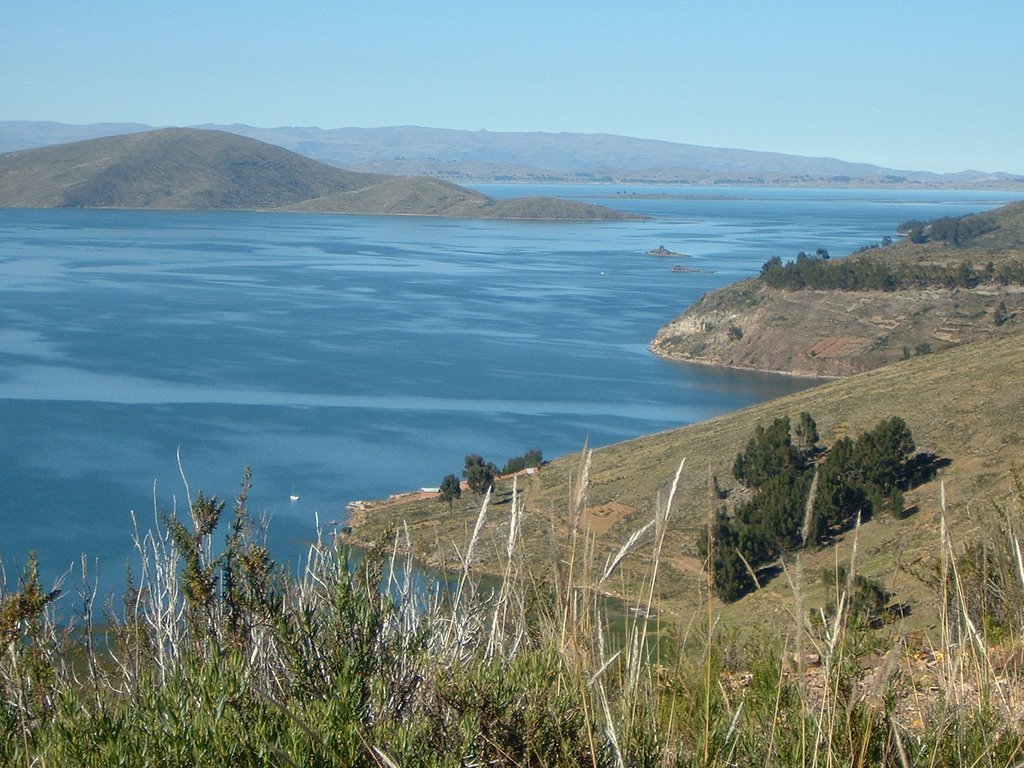
Welcome to Lake Titicaca. You can make fun of the name all you want, but I know you would rather be here than wherever you currently find yourself.

However, I'm not sure you would want to get to the Lake in the same way that I and two other Americans did. Instead of paying $75 to be crammed into a slow-moving minibus with a big tour group, Todd, Carna and I decided to rent a car and drive ourselves to save money. We tried to get a road map from La Paz to Copacabana, but discovered it wasn't very helpful. The only thing the map showed was one line between the two towns ... But, since there is literally only one road you can take, I guess there's not much else to show.

Traveling the solitary road to Copacabana is like traveling back in time 200 years. Adobe brick houses, women in traditional, colorful Bolivian garb, herds of sheep, hairy pigs, cows and donkeys crossing in front of your car. We had planned to stop at a town called Huatajata but we blinked and accidently drove through it without realizing it.

About an hour and a half through the journey, we caught our first glimpse of the Lake from above ... which is what I've posted for you. And that was hardly the best view! The coolest part about the drive to Copacabana is winding through the mountains because you occasionally lose view of the lake, then you go around the bend, and bam! Another view of the lake, even better the previous one.

Two hours into the journey, the road just ends. Yep, it just ends at the water. You have to float your car across on a rickety wooden barge to get to the road, which continues on the other side of the straight. Check out what we saw from our barge - does anyone else see something wrong with the picture below??
Anyway, we finally got ourselves to Copacabana, the biggest little town on the Bolivian side of the Lake, and enjoyed an unforgettably tasty trout lunch. The highlight of Lake Titicaca is exploring La Isla Del Sol (Island of the Sun). But to get there, you have to get a boat ... which you pay for by the motor! It's the same boat, but if you want to use two motors, it costs $60, while it only costs $30 to use one motor. Our solution was to officially pay for one motor and slip an extra 50Bs ($6) into the hands of the boat driver. (FYI, it is cheaper to charter a private boat on Lake Titicaca than to go to DisneyWorld. Which would you rather do?)
On the Island, you can explore the ancient Inca ruins -- in fact, some Incan legend says the first Incas were actually born here, out of Lake Titicaca. I wish we could have spent more time on the Island; I would have loved to camp out here for a night or two. But at least we timed our return trip perfectly -- as we left Copacabana, dusk was just setting in and I watched the colors of the sky change over Lake Titicaca, from clear blue, to indigo, to orange, until the inky blue-black of night crept toward the horizon and enveloped it. Remarkable.

Tuesday, April 18, 2006

A few pictures

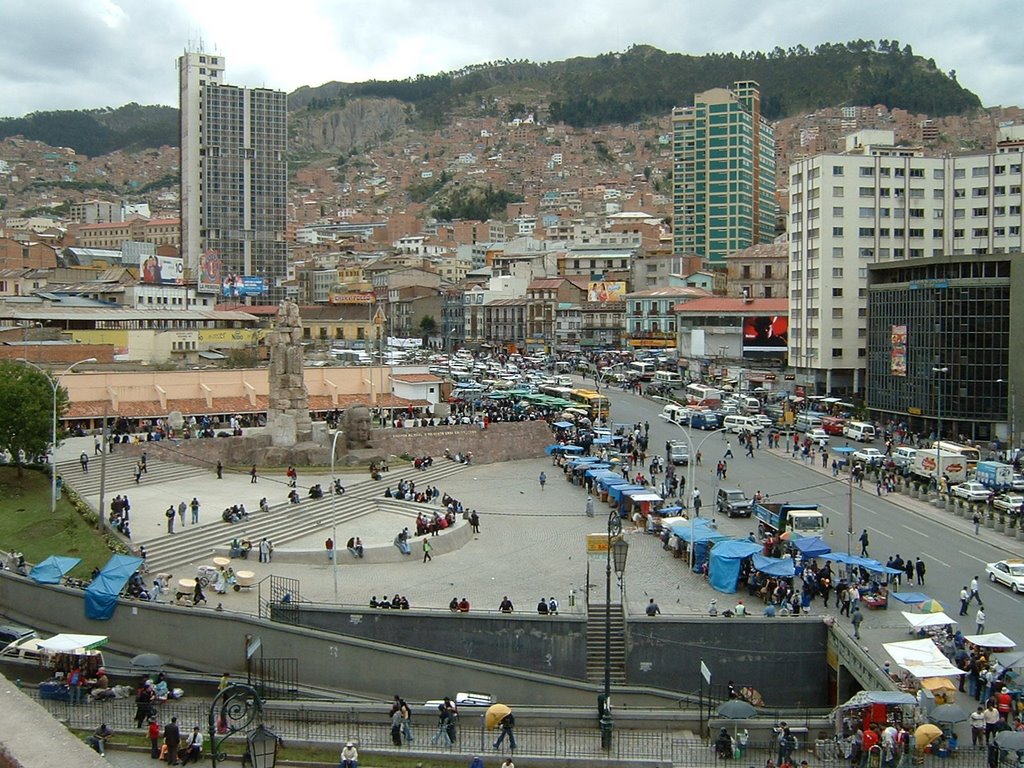
La Paz from the top of the San Francisco Church.
(See, Mom and Dad, I told you it was a real city!)


The Valley of the Moon. We hiked around this bizarre maze of eroded sandstone; saw cactus. Cool, but totally not OSHA-approved.


One of the views of La Paz from El Valle de la Luna. Just imagine what this looks like on a clear, sunny day!